Sunday, April 20, 2008

The Surreal McCoy

I was at Borders in Overland Park recently buying a Jodi Picoult novel for my eldest daughter (Nineteen Minutes, which debuted last year at #1 on the Times list) when I passed the prominent New Paperback table in the center of the store and there they were: My Indiana Jones novels. It has always made me feel a bit surreal to see my books on display, and being confronted by my cycle of Indy adventures, with the new covers with the raised lettering, magnified the effect. Then, on the way back home to Emporia, I stopped at a Dillon's store for a half-gallon of milk and again I passed the Indy books, in the middle of shelf of paperbacks you pass before you get to the checkout. Now, I suppose this should no longer surprise me. I knew Random House was bringing back the novels in time for the release of Indy IV. But I didn't think they'd be everywhere. No, it's not like debuting at the top of the Times list. But it's not like selling books out of the trunk of your car, either.

Tuesday, April 1, 2008

Sunshine in court

Our friends at the Federal of American Scientists Project on Government Secrecy have posted about The Sunshine in Litigation Act, which seeks to prevent court-approved secrecy agreements from hiding information that may be vital to the public health and safety. For more on the proposed legislation, including a link to the PDF of the Senate hearing on the bill, go the the FAS website.

Monday, March 31, 2008

First person paternal

My friend Phillip Finch at Scribo* is putting me to shame when it comes to blogging photos, so here's my attempt to keep up. Here's an image of a talented young singer and actor I took over the weekend at a community theater performance. The lens was a 70-200 Canon L series, the body a 10D, and exposure 2.8/250. Technically the shot could be better -- it isn't as sharp as it should be, considering the glass I was using -- but I like the mood. I hope the young woman likes it.

Thursday, March 27, 2008

Revisiting the (underground) Ozarks

A couple of years ago, I spent an adventurous night with a group of college students who were fond of exploring forbidden places. The experience has stayed with me. Here's a bit of the story that appeared in The Joplin Globe.

CARTHAGE, Mo. -- Midnight. Lost in a labyrinth of rock and water.

"This happens every time," says White Rabbit casually as he dips his paddle into the water and propels the canoe a little further into the unknown. In the bow is Anne, a blond 17-year-old holding aloft a blazing Coleman lantern.

The brilliant light forces aside the darkness as if parting a curtain.

Everything looks the same: clear water tinged with a hint of green, massive pillars of gray rock, brown bats dotting the ceiling. A few bats flit overhead, disturbed by the passage of the 10 adventurers crammed into the canoe and two inflatable rafts.

The air is cool and the water colder, and the subterranean silence clings to the group as tightly as damp clothing. Even though this is their third illegal foray into the abandoned caverns at the edge of town, the group has been paddling around in a circle for nearly an hour, looking for anything familiar that might lead to the way out.

Sertile won't admit to being lost. Later, he will say, it was just a case of "spatial disorientation." Besides, they were only lost for about an hour.

In the past year, the group has ventured into areas that, for a variety of good reasons, are off limits to the public: Abandoned mines and mills across Missouri and Arkansas, the century-old Eighth Street tunnel in Kansas City, and a deactivated Nike missile battery near Pleasant Hill where the group managed to open the missile bay doors.

This sounds improbable, but they've posted video to prove it. It was a little strange, White Rabbit noted, to ride on an elevator designed for nuclear weapons.

The group's Web site, Underground Ozarks, is a combination bulletin board, travel diary, and photo album for urban exploration. The subculture is heavy with codes and aliases, and all nine members of the group identify themselves only by their online handles.

On this Saturday in the middle of October, the group has come to Carthage to gather more material and to probe around the edges of the massive underground storage facility owned by AmeriCold Logistics.

White Rabbit, an affable Missouri State University student from Springfield, doesn't care for the term "urban exploration." It's a $10 word for what nearly everybody has done, he says, at least at some point in their lives. It's about the satisfaction of going places where you don't belong and being able to brag about it later.

Tuesday, March 25, 2008

Found quote

While going through expenses for last year (it's that time, dammit), I discovered a quote I had scribbled on the back of a sales receipt. Curiously, the receipt is for a slice of meteorite I bought at the Wichita Rock Show, while I was doing research for Strangely Heavy: A True Story of Passion and Rivalry in the Meteorite Fields of Kansas. Don't know where I found the original quotation, but it is worth reproducing here: "(It) is a cruel and hollow money trench, a long plastic hallway where thieves and pimps run free, and good men die like dogs. There is also a negative side." -- Hunter S. Thompson.

Tuesday, March 18, 2008

James film among Spur winners

The Assassination of Jesse James by the Coward Robert Ford has also been named a Spur winner by the Western Writers of America. The movie is based on the novel by Ron Hansen, who wrote the screenplay as well.


Other 2008 Spur winners include The God of Animals by Aryn Kyle (Scribner) and Tallgrass by Sandra Dallas (St. Martin's). The complete list can be found here.

Thursday, March 6, 2008

A Spur by any other name...

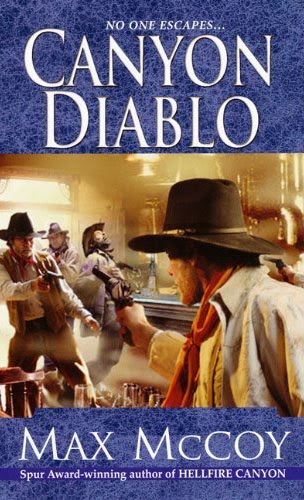
I was notified today that I've won the Spur Award from the Western Writers of America for best original mass-market paperback novel. The award will be given at the WWA convention in June at Scottsdale, Arizona.

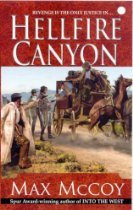
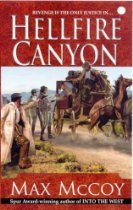
The award is for a novel published in 2007 by Pinnacle (an imprint of Kensington Books) called Hellfire Canyon -- a title I'm not fond of, by the way. My original was Murder Rock. It's the first-person story of 13-year-old outlaw Jacob Gamble, who joins ALf Bolin's band of killers in Taney County, Missouri, during the Civil War. It's an unusual western in that it is an adult novel about a teen-ager, features an unreliable narrator, makes liberal use of footnotes, and in that ALf Bolin was a real-life serial killer.

Here's what the reviewer at Gravetapping Blog said last year:

"Hellfire Canyon is not the typical. There is violence and even gun
play, but there is more—a yearning and understanding of history,
legend, and even folklore. Gamble is an admitted liar, killer and
thief, but he—the story is written in first person—portrays himself never as a victim, but as a survivor."

For some background on the award, this is from WWA:

"The Spur Awards, given annually for distinguished writing about the American West, are among the oldest and most prestigious in American literature. In 1953, when the awards were established by WWA, western fiction was a staple of American publishing. At the time awards were given to the best western novel, best historical novel, best juvenile, and best short story.

Since then the awards have been broadened to include other types of writing about the West. Today, Spurs are offered for the best western novel (short novel), best novel of the west (long novel), best original paperback novel, best short story, best short nonfiction. Also, best contemporary nonfiction, best biography, best history, best juvenile fiction and nonfiction, best TV or motion picture drama, best TV or motion picture documentary, and best first novel (called The Medicine Pipe Bearer's Award).

Winners of the Spur Awards in previous years include Larry McMurtry for Lonesome Dove, Michael Blake for Dances With Wolves, Glendon Swarthout for The Shootist, and Tony Hillerman for Skinwalker."

Wednesday, March 5, 2008

"...two words: governments lie."

The Nieman Foundation at Harvard has created the I.F. Stone Award to honor journalistic independence.

"The I.F. Stone Medal will be presented annuall to a journalist whose work captures the spirit of independence, integrity, courage and indefatigability that characterized I.F. Stone's Weekly, published 1953 - 1971," the foundation said this today in a press release. "Each year, the winner of the award will deliver a speech about his or how own experience with journalistic independence, to be followed by a workshop on the same topic."

So, who was I.F. Stone?

Well, the initials stand for Isidor Feinstein, his birth name. He added the Stone later. He was a muckraker who self-published his weekly newsletter and he died in 1989, at the age of 81. He was a left-leaning investigative reporter who taught himself Greek after retirement and wrote a book on the trial of Socrates. It's ironic that Harvard is honoring him, because for much of his life he was marginalized by the mainstream.

My favorite I.F. Stone quote?

"I am going to tell you a number of things, but if you really want to be a good journalist you only have to remember two words: governments lie."

Monday, March 3, 2008

Active Denial System? $13 million. Giving pesky peace protestors the hot foot? Priceless.

I couldn't believe what I was seeing Sunday night. Was it 60 Minutes or an advertisement paid for by the Pentagon?

I've loved watching the venerable news program since I was a kid, and that's a long time. On Feb. 24, for example, the show did its usual bang-up job on a trio of stories: the politically-motivated bribery conviction of former Albama governor Don Siegelman, the killing of a black reporter who dared tell the truth about a corrupt local business, and the dire implications for all of us due to the disappearance of honey bees due to colony collapse disorder. Even when I don't agree with their approach, I love Morley Safer and Dan Rather and loved (the late) Ed Bradley. Hell, I even liked Diane Sawyer.

But this new guy, David Martin -- who has been the CBS Pentagon and national security correspondent since 1993 and has filed stories for 60 Minutes Wednesday, something I've never watched -- gave a breathless report on the Active Denial System, a non-lethal crowd control device that uses millimeter waves to create a burning sensation . Martin called it "The Ray Gun," and to demonstrate how effective the gadget was, Martin had himself repeatedly zapped by the thing. He writhed dramatically and cried out in pain. I used to hate this sort of thing when local television correspondents would volunteer to be hit with a Taser to show how safe they are (and it turns out they're not that safe). The angle of Martin's piece was that there's this wonderful new non-lethal gizmo that could be used in Iraq to save American lives, it has a range of half a mile, but the chowderheads in charge are refusing to embrace it because it isn't a lethal weapon. Fair enough. Problem is, what was presented as granted in the piece was that crowds (and by association, the right to free speech) must be controlled as a matter of national security.

My disbelief turned to anger when the device was aimed (in a test formulated by the military) at a group of soldiers pretending to be protestors. They were dressed in jeans and hoodies and carried badly-letter signs with slogans which called for world peace. What was implied, of course, is that peace activists are the enemy. They were rowdy, and some of them were throwing rocks at the vehicle upon which the ADS is mounted. Now, was it really necessary that any slogans be written on the signs for an effective demonstration? Blank signs would serve just as well. But then, the Pentagon would be denied the opportunity to slyly get their message across -- a message that was just as wrong in 1968 as in 2008, that "peace now" is code for anti-American. To be ethical, Martin should have declined to participate in, or use the video from, the military-controlled test. At the least, he should have asked those in charge why the enemy was portrayed as peace activists. But no, he couldn't stop gushing about the Pentagon's new toy.

Worse, Martin asked nary a question about whether this device would ever be used to disperse American crowds. Instead, he portrayed it as a way to read the minds of a crowd -- if anybody stays put after being stung with this thing, then they must be an imminent threat and subject to elimination by lethal force. What? If it won't really stop somebody intent on doing damage, then what the hell good is it? Well, it's good for stopping demonstrations and ending free speech, period, and if somebody struggles to keep that right, then they deserve to get shot. The police state isn't coming, it's here, because the news program I have trusted most to bring me the truth is now shilling for the Pentagon. The hard question here wasn't why the military hasn't deployed this thing in Iraq; the hard question is when the government intends to deploy it here.
It reminds me of William L. "Atomic Bill" Lawrence, a NYT reporter who was tapped to become the official correspondent for the Manhattan project. Lawrence, who won a couple of Pulitzers, earnestly (and wrongly) defended the military position that those who survived the bombings of Hiroshima and Nagasaki weren't really suffering any radiation sickness, it was just a ploy to drum up sympathy. It took a rebellious Austrailian journalist, Wilfred Burchett, to violate military orders and venture into ground zero to see for himself the radiation sickness, which he dubbed the "atomic plague." It makes me admire Austrailians more and value Pulitzers less.

Martin has been covering the Pentagon far too long. He no longer sees himself as somebody on the outside, but one of the insiders who is spreading the good news. He didn't even accurately describe how the damn thing works (it uses 96-GHz radio waves to excite molecules just beneath the skin; it doesn't use light or lasers, as the term "ray gun" implies). Martin demonstrated how the waves could penetrate plywood and a mattress, but if he'd had a basic understanding of science he would have used metallic mesh instead. But then, a tinfoil hat would just have looked silly on television -- and it would have given the enemy, those dirty dirty hippies, ideas about how to thwart the gadget.

Martin should go back to Wednesday night -- or better yet, he should go back to local news, where he can be zapped with Tasers during sweeps week until he soils his pants. What was 60 Minutes thinking? Perhaps they were trying to steal some viewers from Fox. By the way, this piece was produced by Mary Walsh, who -- big surprise -- has worked with Martin since he was assigned to the Pentagon.

Friday, February 15, 2008

Quantrill art

Here's the cover art for I, Quantrill. Usually I get this stuff from the publisher, but the first time I saw this cover was on Amazon, where I snagged the image. Because I tend to dislike my covers at first blush, I'll withhold comment for a little while. But at least they kept my title. A May 6 release date is planned.

I'm thinking of putting together a book tour to begin in Lawrence, Kansas, and end in (or near) Wakefield, Kentucky.

Wednesday, January 30, 2008

Hypocrisy at the FCC

The FCC has slapped CBS with millions of dollars in fines for broadcasting "indecent" content. First, there was the Janet Jackson wardrobe malfunction at the 2004 Superbowl which cost the network $550,000. Last year, the commission handed down more than $3 million in fines for a teen orgy depicted in an episode of"Without a Trace." Just this week, the FCC announced its intent to fine CBS another $1.43 million for a bit of skin shown on a 2003 episode of "NYPD Blue."

None of these scenes were particularly graphic. Janet Jackson's exposed (and pierced) breast was allegedly shown by accident, the teen orgy was mostly blurred images of swaying bodies, and the semi-nude scene in "Blue" depicted a small boy getting a bathroom glimpse of a grown woman. Indecent? This wasn't pornography. And it wasn't indecent unless you consider breasts indecent, or story lines that deal with real-life issues. Yes, teenagers sometimes have orgies. The fictional orgy in question, by the way, resulted in consequences. And the bathoom scene in "Blue" was similarly well done.

But even if these fictional scenes hadn't been skillfully executed, the FCC has overstepped its bounds. It is now acting as a story and content editor for CBS, and it has a big stick. Of course, the FCC is bowing under pressure from "decency" groups that would like to ban breasts -- and apparently all depictions of youthful sexuality -- from the air.

It's unfortunate that the FCC has chosen this issue to put its considerable resources behind. The commission is responsible for protecting the public from far more than the occasional breast, and what I find truly indecent is the amount of advertising aimed at children. That type of advertising is banned, with good reason, in most of the world. Apparently, the FCC is dedicated to helping advertisers produce a generation of consumers while giving lip service to the idea of decency.

But judge for yourself. The offending scenes are offered below.


Monday, January 28, 2008

A thousand lies

The Bush Administration lied 935 times in a "carefully orchestrated campaign of misinformation" in the runup to the invasion of Iraq, a new investigation by the Center for Public Integrity has concluded.

I'll save the rant.

But while we're on the topic, 60 Minutes had an interview with the guy who debriefed the captive Saddam Hussein before he was turned over to the Iraqis (and executed). Saddam said there were no WMDs, of course. But what I found troubling is that the FBI agent lied to Saddam on a daily basis for months to get the information. Not only did he pretend to be his friend, but he presented himself not as an FBI agent but as someone who was reporting directly to the president, and held charades to reinforce this impression. The FBI has touted the debriefing as among the top achievements in the agency's 100-year history. Sorry, but isn't it immoral to lie to a man you know will be put to death? But what I found particularly repugnant was that the FBI agent feigned admiration for Saddam's poetry in order to win his confidence. To lie is low, but to lie about literature is a sin.

A long time ago in a land far away, there was a long-held standard that the FBI did not operate overseas and that CIA did not operate domestically. The principle was to keep the FBI from meddling in foreign affairs and the CIA from spying on our own people. Well, we've crossed that Rubicon.

Wednesday, January 9, 2008

The author is always the last to know...

To coincide with the release of INDY IV, Random House is reissuing all four of my Indiana Jones adventures. IJ AND THE PHILOSPHER'S STONE and IJ AND THE DINOSAUR EGGS will be available April 19 (a date that readers of my thrillers will recognize). IJ AND THE HOLLOW EARTH and IJ AND THE SECRET OF THE SPHINX will follow. I didn't have a clue until a colleague came to my office and said she was trying to get copies of the IJ novels for her students but was having trouble... I looked at her blankly, said they are typically available, and then went to the Internet. Found a fansite that said RH was republishing them. Then went to the Random House website and found their catalog and confirmed it. Really, would it have killed somebody in NY to have called and told me? By the way, if you want to read about Indy's first encounter with the Crystal Skull, read PHILOSOPHER'S STONE. The Skull is a continuing story through all four books, ending with SPHINX, the last original Indy novel. The only change in the books is the price, I believe. They are now $7.50.

Tuesday, January 8, 2008

Paging Doctor Bombast

"It's true people sometimes need to be placed under involuntary mental health treatment because they can't take care of themselves," veteran psychiatrist Dr. Jeffrey Sugar said of the 26-year-old Spears. "But there's a difference between being detained involuntarily for psychological treatment and being forced to endure Dr. Phil involuntarily." -- from an AP story about Dr. Phil McGraw's uninvited visit to Brittany's hospital room.

Thursday, January 3, 2008

New law won't change fed secrecy policy

You may have read (here and elsewhere) about the OPEN Government Act, a new law which makes several important changes to the Freedom of Information Act. It is meant to encourage better response times, allow requests to be tracked, and expand the basis for fee waivers. But what it doesn't do, according to the FAS Project on Government Secrecy, is to restore the "presumption of openness" that was demolished by John Ashcroft.

That provision was removed from the bill's final form.

From Steven Aftergood's Secrecy News:

Whatever records that a government agency was legally
entitled to withhold before enactment of the "OPEN Government Act" can still be withheld now that the President has signed it.

Some reporters and editorial writers, perhaps enchanted by the name of the new law, mistakenly assumed that it accomplishes much more than that. "The law ... restores a presumption of a standard that orders government agencies to release information on request unless there is a finding that disclosure could do harm," according to a January 1 Associated Press account that appeared in the Washington Post, the New York Times, USA Today, the Wall Street Journal and elsewhere.

Further, the widely-published AP account continued, "The legislation is aimed at reversing an order by former Attorney General John Ashcroft after the 9/11 attacks in which he instructed agencies to lean against releasing information when there was uncertainty about how doing so would affect national security."

But that is incorrect.

Although the original House version of the OPEN Government Act did include a provision that would have repealed the Ashcroft policy and established a "presumption of openness," that provision was removed from the bill prior to passage.

Thus, Rep. Henry Waxman (D-CA) noted with regret on the House floor on December 18 that the final legislation "does not include a provision which I thought was a key one establishing a presumption that government records should be released to the public unless there is a good reason to keep them secret."

Thursday, December 27, 2007

Ivers on Writing

A fine book is Mitchell Ivers's The Random House Guide to Good Writing. Ivers was managing editor of RH when the book was published in 1991, but he's now senior editor at Pocket Books. His book is just one of a very few writing how-tos I've found helpful, and my copy was given to me years ago by my friend and fellow author Fred Bean -- now the late Fred Bean. And speaking of Fred, his funeral was so strange and poignant (outdoors, with doves and mysterious women weeping in back) that it must eventually become a scene in one of my novels. But back to this book by Ivers, which has been on my writing desk for the last few weeks, along with The Elements of Style and The American Heritage Dictionary. I'm in the midst of proofing galleys of I, Quantrill, to be released in May 2008 by New American Library, and I find the Ivers book an excellent reference. In the interest of disclosure, NAL is an imprint of Penguin, but I don't deal with Ivers because he is so far up the food chain. The Guide is still in print and can be had in a mass market edition for about seven bucks from Amazon.

Tuesday, December 25, 2007

A fine pair from Texas

Two winners from the Texas Monthly 2008 Bum Steer Awards, one about a former Pittsburg State University football coach and another about a television journalist who was nabbed for suspicious behavior in the maternity wards of a couple of Amarillo hospitals.

"Of all the Bum Steer sagas that played out over the past year, however, none was stranger than that of the man ESPN called “dumber than a blocking sled.” Yep, it’s the Aggies’ own Dennis Franchione. His $2 million salary evidently wasn’t enough; he moonlighted as the author of a VIP newsletter, which he sent out by e-mail to 23 well-heeled boosters willing to pay $1,200 for inside dope about injuries and recruits. Unsportsmanlike conduct! When A&M learned of his other gig, the university had to report two rules violations to the NCAA. Even beating Texas two years in a row couldn’t keep him in his job. Congrats, Coach Fran. You’re the Bum Steer of the Year."

Well, my (admittedly slight) connection to Franchione is that I got my undergraduate degree at PSU. I often say in my journalism class that sports really isn't news unless they execute the losers. But I'll make an exception for greed and corruption.

And this gem:

"Coming up at ten: She does five. Cecelia Lynn Coy-Jones, a reporter for KCBD-TV, in Lubbock, was arrested for attempted aggravated kidnapping after lurking in the maternity wards of two Amarillo hospitals, because, she claimed, she was investigating how secure they were from would-be kidnappers."

I'm all for enterprise reporting, but when you appear to be a threat to children, you're begging for trouble. My advice to Coy-Jones: While the occassional stolen baby story makes for breathless copy, it's the damned politicians and bearucrats that really need watching. Lurk in city hall instead.

That's no moon... it's season's greetings.

Each year, I get a holiday card from Lucasfilm (because of some Indiana Jones novels I did a few years back). Every card is a whimsical take on some part of the Lucas universe. This year had three rows of pop-up stormtroopers holding candles and songbooks. And, as usual, the card said a donation had been made in my name to charity. it also had a handwritten greeting from a top Lucasfilm employee (no, I don't mean George). Christmas is not my favorite time of year -- that would be Halloween -- but I do look forward to getting these seasonal tidings from my friend at the Presidio.

Wednesday, December 19, 2007

If Bush thinks it's bad... it must be good.

In my journalism classes, I stress the importance of open records and require all of my students to file at least one request per semester. Secrecy, however, has been the rule at the Bush White House, and a campaign has been waged to diminish FOIA -- the federal open records act -- and to encourage officials to ignore, delay, and deny requests. The issue is so important that I include here, in full, an upate on an attempt to strengthen FOIA.

From the National Security Archive:

House Poised to Pass FOIA Reform Bill

Bill Provides “Common Sense” Solutions for Openness Problems:
Penalties for Delays, Tracking Systems for Requests,
Ombuds-style Office to Mediate Disputes, Better Agency Reporting

Reforms Recommended by Archive Audits and Testimony

Washington, DC, December 18, 2007 – The House of Representatives will vote today on a Freedom of Information Act (FOIA) reform bill (S. 2488) that passed the Senate by unanimous consent on December 14. The bill aims to fix some of the most persistent problems in the FOIA system, including excessive delay, lack of responsiveness, and litigation gamesmanship by federal agencies. If passed by the House today, it will be sent to the President’s desk for approval.

“Our six government-wide audits of FOIA performance show that these bipartisan changes to the Freedom of Information Act are common sense solutions,” remarked Meredith Fuchs, general counsel of the National Security Archive. “This bill establishes tracking systems for FOIA requests like FedEx uses for packages, actually penalizes agencies for the first time for delays that our audits found could reach 20 years, and sets up an office to mediate disputes as an alternative to litigation.”

The bill in front of the House today represents a bipartisan effort that has stretched over several years, spearheaded by Senators Patrick Leahy (D-VT) and John Cornyn (R-TX), the original co-sponsors of the OPEN Government Act of 2007, Senator Jon Kyl (R-AZ), and Congressman Henry Waxman (D-CA). Efforts to amend the FOIA have faced stumbling blocks in part because of strong administration opposition to passage of earlier versions of this FOIA reform bill in both the House and the Senate.

“This is the bill that President Bush wrote an executive order to try to prevent,” said Tom Blanton, director of the Archive, referring to E.O. 13392 (December 14, 2005), which called for a “citizen-centered and results-oriented approach” to FOIA, established Chief FOIA Officers at each of 92 major agencies, and required agencies to evaluate their FOIA programs and draft improvement plans.

The new law would mandate tracking numbers for FOIA requests that take longer than 10 days to process to ensure they will no longer fall through the cracks, require agencies to report more accurately to Congress and the public on their FOIA programs, create a new ombuds office at the National Archives to mediate conflicts between agencies and requesters, clarify the purpose of FOIA to encourage dissemination of government information, and provide incentives to agencies to avoid litigation and processing delays.

“Congress is acting to improve the FOIA for the first time in more than a decade, since the electronic FOIA amendments of 1996, but Congressional and public oversight will be essential for the law’s success,” Blanton noted. “Our Knight Open Government Survey in 2007 found that only one in five federal agencies fully complied with the 1996 law, even after 10 years of implementation.”

Monday, November 12, 2007

Unnatural Bridge

Not far from the castle (see post below) at Ha Ha Tonka Park is a natural bridge. It seemed more than a little spooky to me. I couldn't help but wonder how many crimes have been committed in the shadows below. The park is located near Camdenton, in the heart of Missouri's spectacular karst. There are lots of caves, cliffs, and sinkholes. The name of the park allegedly means "laughing water" in Osage, but I'm suspicious -- having studied more than a few Native American words, I'd guess that it means something closer to "sacred waters." Or not. The photo below is a tighter shot, showing the arch, which is quite large -- large enough, in fact, for several adults to stand beneath with plenty of headroom. You could even get horses in there. A great place to hide and a terrific setting for a story.

Ozark Olympus

Okay, this is one of the weirdest things I've encountered in a spell. I went trout fishing at Bennett Spring (catch and release only this time of year) over the weekend and, since I was close, took a side trip to Ha Ha Tonka State Park. On the top of the highest mountain are the ruins of a castle built by a Kansas City businessman named Snyder in 1905. Snyder died in an automobile accident in 1906 (yes, one of the first car accidents in Missouri) and the castle operated as a hotel until it burned in 1942. What's left is surreal. The Roms (the Romantics) would have loved it. The ruins would be a terrific place for a Shakespeare festival. I can easily imagine Hamlet performed below.